TULARE
— The air outside smelled of barbecue smoke and exhaust fumes Tuesday during
the opening day of the World Ag Expo, but inside the Heritage Complex banquet
hall, a look into the future of agriculture was taking place.
In
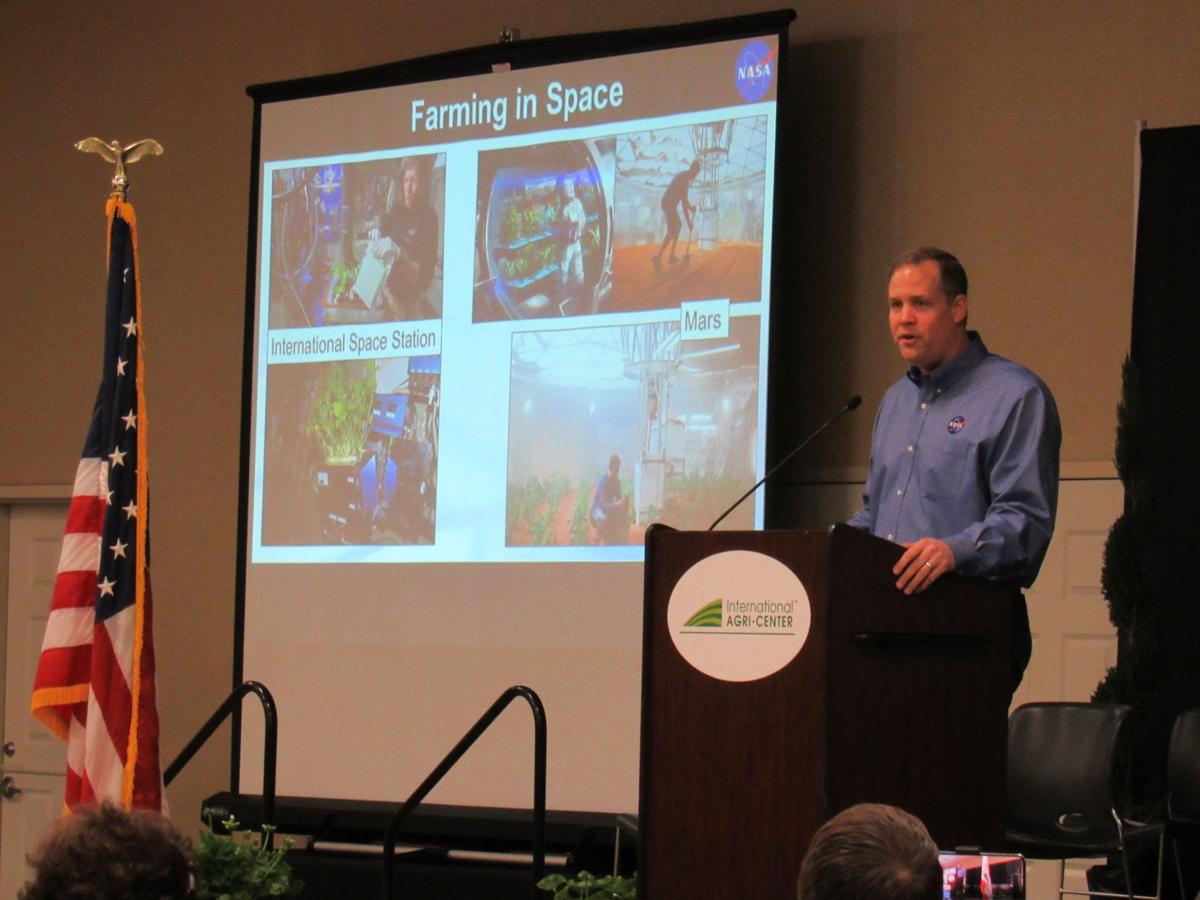
keeping with the expo’s theme, “Harvesting Technology,” NASA Administrator Jim
Bridenstine visited the International Agri-Center in Tulare and spoke about how
technology originally developed for space exploration is now being repurposed
and used to improve numerous aspects of agriculture around the world.
Though
NASA makes up only a fraction of 1 percent of the federal budget, Bridenstine
said the agency is responsible for a lot of the technology we use today, from
GPS to weather satellites.
“People
don’t realize how important space is to their lives,” he said. “Space has
elevated the lives of everybody in the United States of America, and in fact,
all across the world.”
Although
he’s not from this state, Bridenstine actually spent some time as a Navy pilot
in California, including at Naval Air Station Lemoore, so he said he is
familiar with the agricultural issues here.
One of
the biggest challenges is the competition for water under growing demand, he
said. He said it’s becoming more and more difficult to manage this precious and
scarce resource in a responsible way.
Currently,
Bridenstine said NASA has unique technology it is sharing with the California
Department of Water Resources that can be used to measure the Sierra Nevada
snowpack and determine how fast it is melting.

He said
LIDAR (Light Detection and Ranging) technology — originally used to map the
moon and Mars — is used to map the mountains before and after snow has fallen
to get a water equivalent measurement, while spectrometry is used to calculate
how fast the water is melting.
The
ultimate objective is to make sure no water is being wasted, Bridenstine said.
NASA is
also helping specific farms in the state by measuring evapotranspiration, which
is when water is transferred from land to the atmosphere when it is evaporated
from soil or transpired from plants.
The
measurement, also taken with LIDAR, can be used to calculate precise irrigation
needs of plants and crops. Bridenstine said this pilot program, in partnership
with the University of California Cooperative Extension and other agencies, is
only being used in California.
So far,
Bridenstine said results have shown 20 percent reduction in water use and 50
percent reduction in nitrate leeching, sustaining crop yields and quality for
less water. He said NASA wants to improve the technology and expand to broader
regions.
Bridenstine
also talked about GRACE (Gravity Recovery and Climate Experiment) data being
used to measure the amount of water in soil and in the aquifer. He said the
data can be used to predict drought, which can be beneficial to policy makers.
“When
there are people that need support we need to get it to them ahead of time, not
afterwards,” Bridenstine said.
Even
though NASA technology wasn’t originally created to benefit agriculture, it has
been able to and Bridenstine said ultimately, the goal is to figure out how to
grow food, save lives, feed more people around the world and conserve
resources.
“Through
partnerships with universities and states we’re actually able to make a
difference and we want to continue doing that,” Bridenstine said. “As the NASA
Administrator, I’ll be doing that as much as I can, so that every piece of
technology we develop ultimately gets fed into its best uses for all of
humanity.”
The
measurement, also taken with LIDAR, can be used to calculate precise irrigation
needs of plants and crops. Bridenstine said this pilot program, in partnership
with the University of California Cooperative Extension and other agencies, is
only being used in California.
So far,
Bridenstine said results have shown 20 percent reduction in water use and 50
percent reduction in nitrate leeching, sustaining crop yields and quality for
less water. He said NASA wants to improve the technology and expand to broader
regions.
Bridenstine
also talked about GRACE (Gravity Recovery and Climate Experiment) data being
used to measure the amount of water in soil and in the aquifer. He said the
data can be used to predict drought, which can be beneficial to policy makers.
“When
there are people that need support we need to get it to them ahead of time, not
afterwards,” Bridenstine said.
Even
though NASA technology wasn’t originally created to benefit agriculture, it has
been able to and Bridenstine said ultimately, the goal is to figure out how to
grow food, save lives, feed more people around the world and conserve
resources.
“Through
partnerships with universities and states we’re actually able to make a
difference and we want to continue doing that,” Bridenstine said. “As the NASA
Administrator, I’ll be doing that as much as I can, so that every piece of
technology we develop ultimately gets fed into its best uses for all of
humanity.”

No comments:
Post a Comment